flourish.algy.me.uk
Sheffield Flourish Cast Writers' Group
Woodhouse, Day 2, Morning
by Brian
posted on 2026_08_01
The author acknowledges the invaluable pre-publication copy-editing performed by Chris Bellamy.
Day 2 — Saturday 26th June 2060 — Morning
It’s Saturday just after 13:00, but it has been a very full morning, which included an unexpected encounter and a fascinating yet worrying chat with Old George.
I went up to the breakfast room at 07:00, my normal time. We don’t have any catering facilities in our flats, and so we have to get all our meals in the cafe on the top floor, which is the third storey above ground. All the communal facilities are on that floor. The two floors below it are reserved for government officials and other privileged people. As my normal seat is beside a window, I’ve never found it already occupied. I like sitting there so I can look out, but not many others share my interest. Since it is Saturday, I didn’t bump into Jane who has recently joined me at my table. She likes to sit at an angle in her seat facing away from the window. I missed her warm smile and friendly chatter. Unlike me, she actually has a job and attends her workplace at one of the other Blocks on weekdays, travelling on the underground railway system that connects the Blocks. She is a biotechnician, whatever that is. One day, I must ask her about that. I call her Jane, but actually we haven't exchanged names. I've been planning to ask for hers for a day or so, but my habitual shyness gets in the way.
I stayed in the cafe eating until 08:00, which is my normal time for finishing breakfast. I left my seat, walked out into the corridor to the lift and waited. Once inside, I pressed the button to go to the tenth floor, which houses my flat. The Block has three floors above ground and twenty-seven below.
As I arrived at the door to my flat, the door of the adjoining apartment opened and a tall man in his sixties emerged. He nodded at me and approached with his hand outstretched, a broad smile on his face. Despite the smile, I got the impression that he wasn’t happy-go-lucky. What stuck in my mind was how extremely businesslike he seemed. Of course, manners meant that I had to shake his hand even though I had never seen him before and I was expecting the new tenant to be a youngster, straight out of the Block school, as had been reported by the local rumour mill.
He introduced himself as Philip Seaton and said that he’d just moved into the flat next to mine. He promised that he was quiet and well-behaved and wouldn’t be any bother.
“But ... but... we were expecting a younger person!’ I stammered.
‘Yes, I guess you were,” he responded. “But I’m a government official on a visit from Heeley Block. There is currently no space for me on the floors above. I shall only be here for a few weeks and after I’m gone, I expect that my place will be taken by a youngster from the Block school and things will revert to normal. In the meantime, please don’t be alarmed. There really is nothing to worry about.”
“OK,” I replied as he walked away and I returned to my apartment. As I closed the door behind me I realised the stranger hadn’t asked my name. Perhaps he knew it already — which was unsettling. Suddenly, I felt even more watched than normal.
Government officials, even visiting ones, were always housed above ground with the privileged and away from the hoi polloi. His presence down here was worrying, but I had no time to think about that then. I was due to meet Old George in the library at 08:30 and he got crotchety if people weren’t punctual. I wouldn’t get anything useful out of him if he got crotchety. Like many of those who weren’t born in the Blocks, he has a great talent for grumbling.
The library is a large room on the top floor with no windows. It doesn’t contain any actual books as a library in the old days would have, but instead many terminals giving access to the local archive and to the wider world. Of course, it has several microphones and cameras to monitor us constantly, but Old George has discovered a corner where the microphones don’t reach. Provided you look away from the cameras when speaking, you can’t even have your lips read by the conscientious government lackeys who staff the data feeds day and night. Sadly, the library as a library isn’t as useful as one might hope. I’ve come to realise over several years that either the archive doesn’t contain a full history of the world, or, if it does, that most of us are denied access to it.
I arrived at 08:20 and I made a beeline for George’s favourite corner.
As one of those who had moved into the Blocks voluntarily in 2030, Old George had a real name and I had discovered it was George Warmsley. George because his parents gave him that name, and Warmsley because that was his father’s family name. He was known as Old George because he was one of the oldest of the original inhabitants of Woodhouse Block who was still active. Unlike others in his age-group, he had thrived. His contemporaries had mostly disliked being locked indoors and had slowly declined into despair and/or ill-health.
George joined me at 08:25, smartly dressed in a jacket and tie. “Good,” he said. “You’re here already. I like a man who turns up on time. It shows that he has respect for those he is about to meet. Respect isn’t valued much these days. Now, what do you want to talk about? I haven't got all day.”
“The outside,” I replied. “What do you remember about the time before you came in here? Why did you come in here?”
“Hey, that’s a big subject and one that could put you in danger. You know as well as I do that the Government doesn’t like to talk about the outside and doesn’t like us asking questions about it. Are you sure you want to know?”
“Certain,” I replied. “I want to know what’s going on and what went on before I was born.”
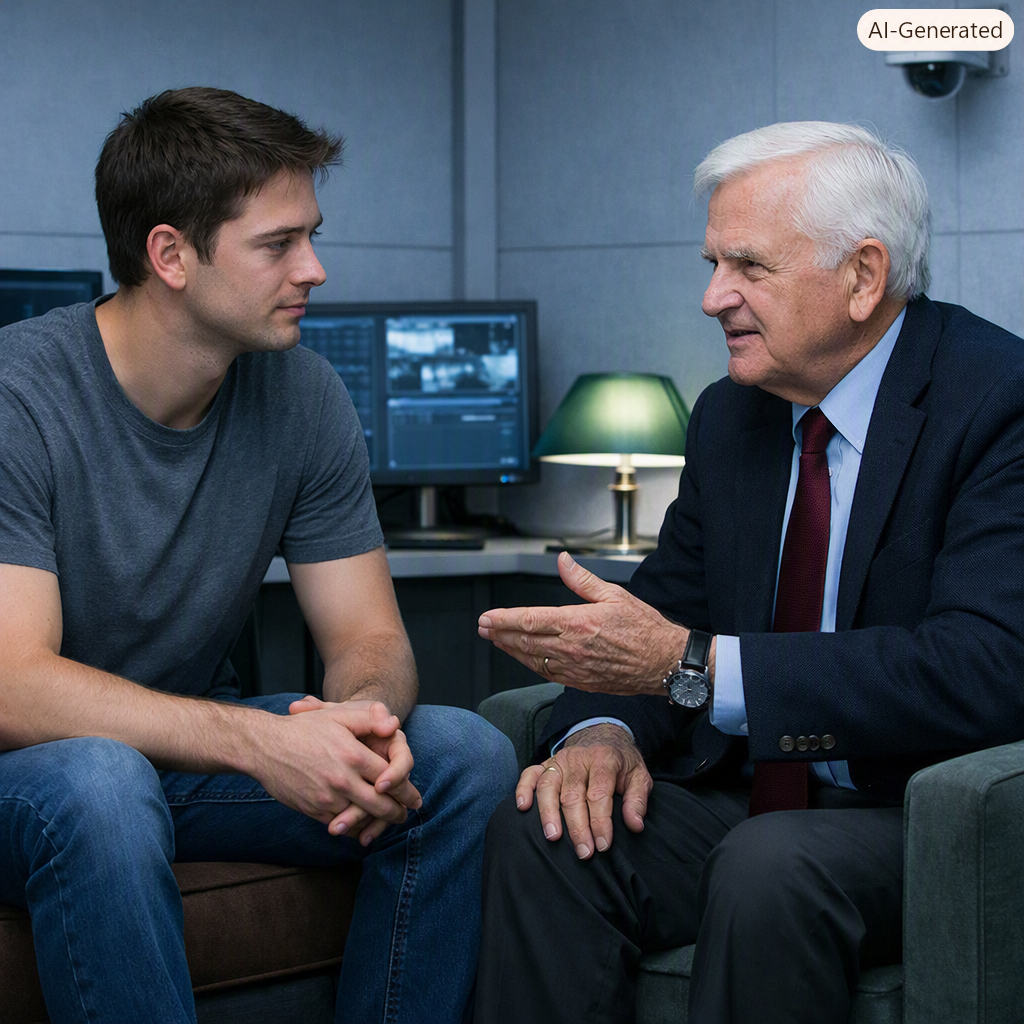
“Very well, youngster, but I’ve warned you. This is all your decision. I don’t want any blame coming back on me if you get into trouble. I may be seventy years old, but there are still books I want to read and things I want to study before I die. Life here may be quiet and boring for lots of people, but I like it as it is. I’m what used to be called a ‘bookish’ person. I’ve no time for any excitement. I want to die in my bed. You seem destined to die with your boots on, if you know what I mean?”
I didn’t know, but I guessed that I didn’t want to find out. However, my curiosity was getting the better of me. “Ok, George. I won’t tell anybody what you tell me. Let’s start with what life was like outside before you and lots of other people moved into the Blocks in 2030.”
“I was born in the year 1990, but I don’t remember anything until about 2001 when I went to what was called secondary school. Before that I’d attended a primary school, but that was mostly play and it didn’t interest me much. Secondary school meant actual, serious studying, which I for one enjoyed, though I was in the minority. The downside was that some of the pupils didn’t enjoy it at all and were naughty, which spoilt it for those of us who wanted to learn. I really don’t know how the teachers put up with it!”
“The kids were disruptive?”
“All the time, some of them. If they passed a certain number of offences or, if what they did exceeded a certain measure of seriousness, they were excluded from the school. A teacher needed many other talents than teaching. Most couldn’t put up with it and left the profession.”
I told him that I didn’t remember any such trouble during my years at the Block school.
“That’s because discipline was enforced right from the first day,’ he replied, “and kids learn to behave quickly in that environment. They also learn what they’re meant to learn. In my day, teachers weren't allowed to discipline misbehaving pupils. The only redress, eventually, was exclusion. Only parents were allowed to punish their children, but even then there were very strict limits. Unfortunately, quite a lot of parents had no ability or wish to discipline their kids, probably about ten percent of them. It’s one reason why, in 2030, with the opening of the Blocks, the State took over the care and education of all children from birth. They said it was obvious that that was in the interests of the children. There was a lot of anger about that decision, but ultimately, force majeure had its way, as it always had and always will.”
I thought about that for a good minute. I had always been used to not knowing who my parents were, but I had never known why.
“So,” I mused, “the government took all new-born children away from their parents and placed them into state homes. Surely they didn’t do that just because of some badly-behaved kids in school?”
“No. Not just because of that. There was actually a far more serious reason. For some decades there had been some really terrible scandals involving children being sexually abused by adults. Mostly this did not involve the parents, but rather organisations set up to groom children for the benefit of their clientele. The perpetrators were mainly wealthy men, some well-known to the public, who could afford to indulge their desires.
These men generally got away with it, as, if they were exposed, they would name their fellow abusers, some of whom held senior positions in business, politics or law-enforcement. There was often graphic video evidence, some of which was made public on Social Media, when that was still around. It was almost as if these men were forced to be filmed indulging their passions so that they could later be controlled by those who sought to use them for whatever reasons.”
“That’s really awful. Has the abuse ended?”
“Maybe,” George replied. “There were a few prosecutions, but only of minor figures who had no power to drag their more powerful fellow offenders down with them. There were no more public scandals, at least. I hope that this means that the abuse is no longer happening, but given the total government control of children these days, it would be even easier for the abuse to be carried on and covered up. Any abused child could be quietly disposed of as soon as they grew old enough to be undesirable or if they were threatening to blow the whistle. These days, the public has no way of knowing about such criminal activity by our leaders, and possibly, after thirty years of the Blocks, no interest in finding out. Furthermore, there is the possibility that the measure they said would protect our children actually does the reverse.”
George had been right. I really hadn’t wanted to know what he had told me and I needed to digest it properly, which would take time. I made a mental note to ask him about ‘Social Media’ at some future date. I’ve never heard the term before this morning. For the moment, I moved him on to my second question. “Could you tell me why you and other people chose to enter the new Blocks?”
“There was a lot of disquiet in the population in the years leading up to 2030. The threat of climate change had been with us for about thirty years by then, but no really serious actions to avoid its consequences had been taken. The weather got unbearably hot even in our once temperate climate here in England. Most people couldn’t afford to protect their homes from this new environment. In those days, we still used money and it wasn’t divided up fairly. A few very rich individuals held about 99% of the wealth, leaving the rest struggling to make ends meet. This caused a huge amount of resentment and trouble was bubbling up all over America, the UK and Europe.
There was a global pandemic which persuaded the governments of all countries to take radical steps to stop its spread. These steps included those that infringed on personal freedoms and many people resented the imposition of lockdowns and the mandating of untested vaccines on key workers. Shortly afterwards there followed two major wars. They persuaded the governments of the West to put their countries on a war footing, which involved further authoritarian measures by them. These were the final straws that broke the camel’s back. I can remember my old dad, when he was as old then as I am now, saying that he was glad he wouldn’t be alive when things really got bad. He wasn’t on his own. It was the view of many senior citizens. They feared for their grandchildren. Many younger people decided not to have children. Following mass protests, the government announced their plan for the Blocks, promising that they would protect all who came inside, keeping them safe from any future pandemics and the inclement climate. On top of this they promised that nobody would need money to live, that all had the right to a safe life with dignity. Most of the work would be done by robots and AIs, though there would still be work required of a small number of people, and it was expected that this number would decline in time. For most people though, their most important promise was that they would take no further part in any military operations of any kind apart from actual self-defence. England would remove itself from all military alliances and declare itself neutral.”
“I knew about the climate change and the pandemic, though not about the wars.” I responded. “What particularly persuaded you to come inside?”
“The main reason was because I hated the slow, but insistent beat of the war drums. I thought that our leaders were all crazy and didn’t know the risks they were taking. I also wanted a quiet life, without having to waste time working for a living. I was, and still am, single. I had family, but I didn’t feel much kinship with them: they treated me like an outsider as I wasn’t like them. I came inside and they all remained outside. They said they wanted ‘freedom’. I wanted it too, but I defined it differently. I wanted the freedom to do what I wanted, when I wanted, but I didn’t mind the state control that came with it that stopped me doing stuff that I didn’t particularly want to do. My family resented the control. I spent my childhood having to do what the rest of the family wanted. They never respected my wishes. My older sister often quoted democracy as a justification. She herself was in the majority, and, like many others, thought that the minority just had to put up with their lot.”
I asked him if he had ever thought that he may be playing into the hands of those who sought to control us.
“I did, but I was and am too selfish to care,” he replied. “I’m only responsible for myself, others have to take care of themselves.”
By this stage, I almost had too much to think about, so I asked my final question for today. “Do you know what percentage of people came inside?”
Old George replied. “I really have no idea, but you may be able to work it out. The populations of all the blocks are stable as births are only allowed to replace deaths and those figures should be available in the archive. Pre-2030 there was a census every year in the years ending in a “1’, and it’s possible that the archive will hold the 2021 census details. It may even let you look at them.”
“Thanks George. Can we meet here again tomorrow at the same time?”
“Of course. I spend most of my life in here, reading and writing, so it isn’t any trouble. I don’t know what else I can tell you though.”
With that, I left him, rode the lift back down to my flat, took the Pukka Pad and the pencil from their hiding place, and started writing.
Continued here
