flourish.algy.me.uk
Sheffield Flourish Cast Writers' Group
Woodhouse, Chapter 6, Day 4, Afternoon
by Brian
posted on 2026_10_19
Day 4 — Monday 28th June 2060 — Afternoon
I got back to my flat and started researching. PLAYFAIR was not a word that I had heard before, so I needed to search for it in the archives. The archive turned up several things, but the relevant one was clearly the Playfair cipher, which confirmed my earlier assumptions. It looked like Old George had encrypted messages into his crosswords, using this cipher.
A certain Charles Wheatstone invented the Playfair cipher in 1854, though it was named after Lord Playfair, who promoted its use. It was one cipher used by the British forces in the Second Boer War, World War I and World War II. It is reasonably fast to use and requires just a pencil and paper. It was breakable before World War I, so was only used for limited tactical communications that would cease to be important within a few hours.
The archive recorded an amusing bit of history I couldn’t resist repeating. Wheatstone tried to sell his idea to the Foreign Office, but they rejected it as too complicated. Wheatstone then offered to demonstrate that three out of four boys in a nearby school could learn to use it in fifteen minutes. The Under Secretary of the Foreign Office responded, “That is very possible, but you could never teach it to attachés.”
The archive described it as a symmetric encryption method employing bigrams, also known as digrams. Of course, this was well over my head, but if schoolboys could master it, then so could I. Luckily, the archived article on it was very clear and used worked examples. I took up my Pukka Pad and pencil and got to work.
I will not detail the operation of the cipher here. All I need to say is that it needs a keyword known to the sender and the receiver and the encrypted string of characters making up the secret message.
The crossword messages described in this and later chapters are based on genuine Playfair cipher encryptions. Readers interested in a description of the cipher with worked examples, can consult this page.
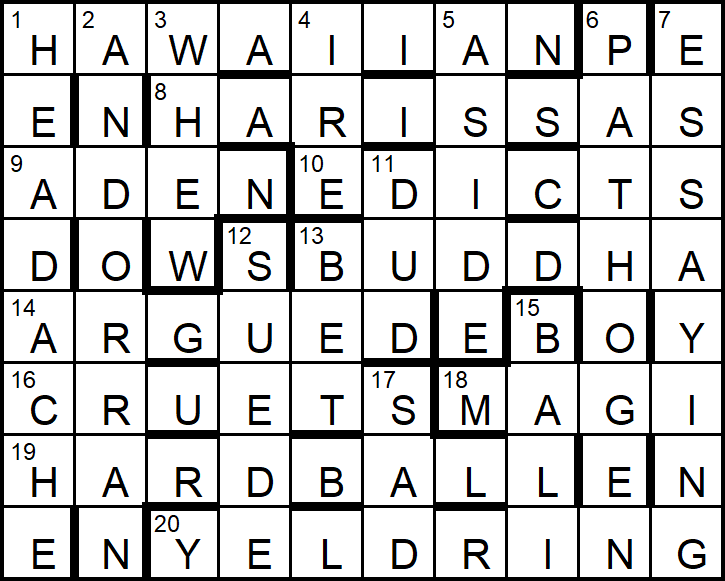
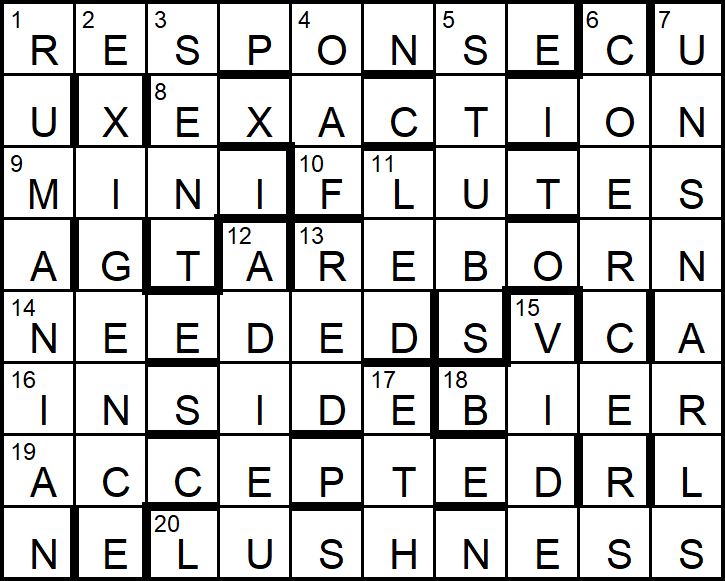
After I had mastered the cipher — in less than fifteen minutes, I might add — I considered how it might be used to encrypt a message in a crossword puzzle. The solution to Ellie’s latest Sunday puzzle had been published this morning, and the solution to Old George’s Wednesday puzzle last Thursday. So I had two examples to work with. I have drawn the solutions below.
Old George’s Puzzle
Ellie’s Puzzle
My primary assumption, which seemed reasonable, was that the sender wouldn’t anticipate the recipient needing to solve the puzzle. That might expect too much, or perhaps take too long. This led to the conclusion that everything the recipient needed to decrypt the message had to be present in either the clues or the solution, or perhaps a combination of the two, and this included the keyword. It would be difficult for Old George to communicate a new keyword to Ellie and anybody else who was in on the procedure, but a crossword puzzle was full of many words — where better to hide a keyword?
I first considered the clues only, but soon realised that this would be far too difficult to construct. All the clues appeared in English, and if the setter actually encrypted parts of them, they would need to be a genius to arrange them to make sense for the answers and the secret message. I knew Old George and Ellie were smart, but I hadn’t so far got any evidence that they were geniuses. However, it was still possible that the keyword was hidden in one of the clues — always the first one across or down, perhaps. That would be relatively straightforward to arrange. Apart from that though, the message just had to be in the solution.
This made sense, as surely a setter first filled in the grid with words and then wrote the clues? If the keyword and message were both in the solution, the entire process would be more straightforward. Straightforward, yes, but not so easy. Filling a grid with a keyword that the receiver would know was the keyword immediately, and then filling in the rest of the grid would be possible, but tedious in the extreme. Then I remembered Old George had been a programmer all his life. Perhaps he had written a program to do it for him? Perhaps this had been part of the research he had been referring to?
Leaving the keyword aside for the moment, I next thought about the encrypted message. Being encrypted, it wouldn&arsquo;t make sense until decrypted. That meant it must use some letters in the grid in some kind of order. It occurred to me that the grid would be easier to fill if the letters making up the encrypted message were each only part of one word. That means that they were in the unchecked squares, or the ‘unches’ as the archive taught me to call them. This suggested that the messages had to be short. If all the unches were used, then surely the grid would be impossible to fill to complete a correct crossword? As I had noted this morning, the puzzles varied in size. Perhaps the shorter messages were in the smaller grids? The largest grid I had ever seen was 15x15, so there had to be a maximum size to the message.
At this point I realised that the barred crosswords always had fewer unches than the blocked ones. This surely would make it easier to fill a grid after the unches had been filled with encrypted letters. I checked in the archive. For the last year, Old George had only been setting barred crosswords! I checked Ellie’s puzzles. She had been doing likewise, also for the last year. That settled it. The keyword and the message were both in the solutions and were only present in the barred puzzles.
The keyword, then. The Playfair cipher was a little easier and less error-prone if the keyword didn’t contain any repeated letters. This would narrow down the receiver’s search. The cipher was also harder to crack the longer the keyword was. So, I concluded, the keyword was one of the longest answers in the grid that had no repeated letters.
What about the message, though? In which unches was it present and in which order? I could only find out by trying to crack the cipher using the two puzzles I have drawn above. It was only at this stage that I noticed that both examples I would try to decrypt used exactly the same grid. Was this a further clue?
I won’t go into the details of my cracking of the codes, but I managed it, and it was along the lines that I have described above. The message in Old George’s puzzle was ‘GIVE BILLY CODEWORD’. Ellie had done exactly that, and her reply — ‘WILL DO MONDAY’ — confirmed it. These messages made so much sense that they just had to be right.
I was feeling very pleased with myself at this stage, but there was something else to worry about. Was the cipher secure? Had the authorities perhaps already noticed it and cracked it? To make that happen, they first needed to realise that the puzzles held a secret message. Given that they knew of the connection between Ellie and Old George and that they both set crosswords, then it was very possible that they had got that far. However, they had to work out which cipher was being used. If they got that far, though, then they could decode the messages as easily as I had.
All these security concerns got me thinking about this journal. It was now even more vital that the authorities did not discover it. Carrying it around with me, rather than leaving it anywhere inside the Block, was also risky. This led me to the conclusion that I had to find somewhere outside to stash it. This gave me new impetus to find a way to the outside world. I knew it was possible to get there — the maintenance workers did so officially and repeatedly, but I didn’t feel confident enough to engage one of them for help. Perhaps I should destroy the journal? Old George knew about it — he had even given me the Pukka Pad — but did he know I was writing all of his and Ellie’s secrets in it? What would they think of the weak point in their security that they didn’t even know about?
Continued here
